The Plan and the Promise
When Edward I established the new town on Iham ridge in the 1280s, defence was part of the brief. Old Winchelsea, down on the shingle spit below, had been raided and battered repeatedly before the sea finished it; the new town was positioned partly for its height, its steep scarps providing natural protection on three sides. The eastern approach, where the ridge meets the surrounding land most gently, was always the soft point.
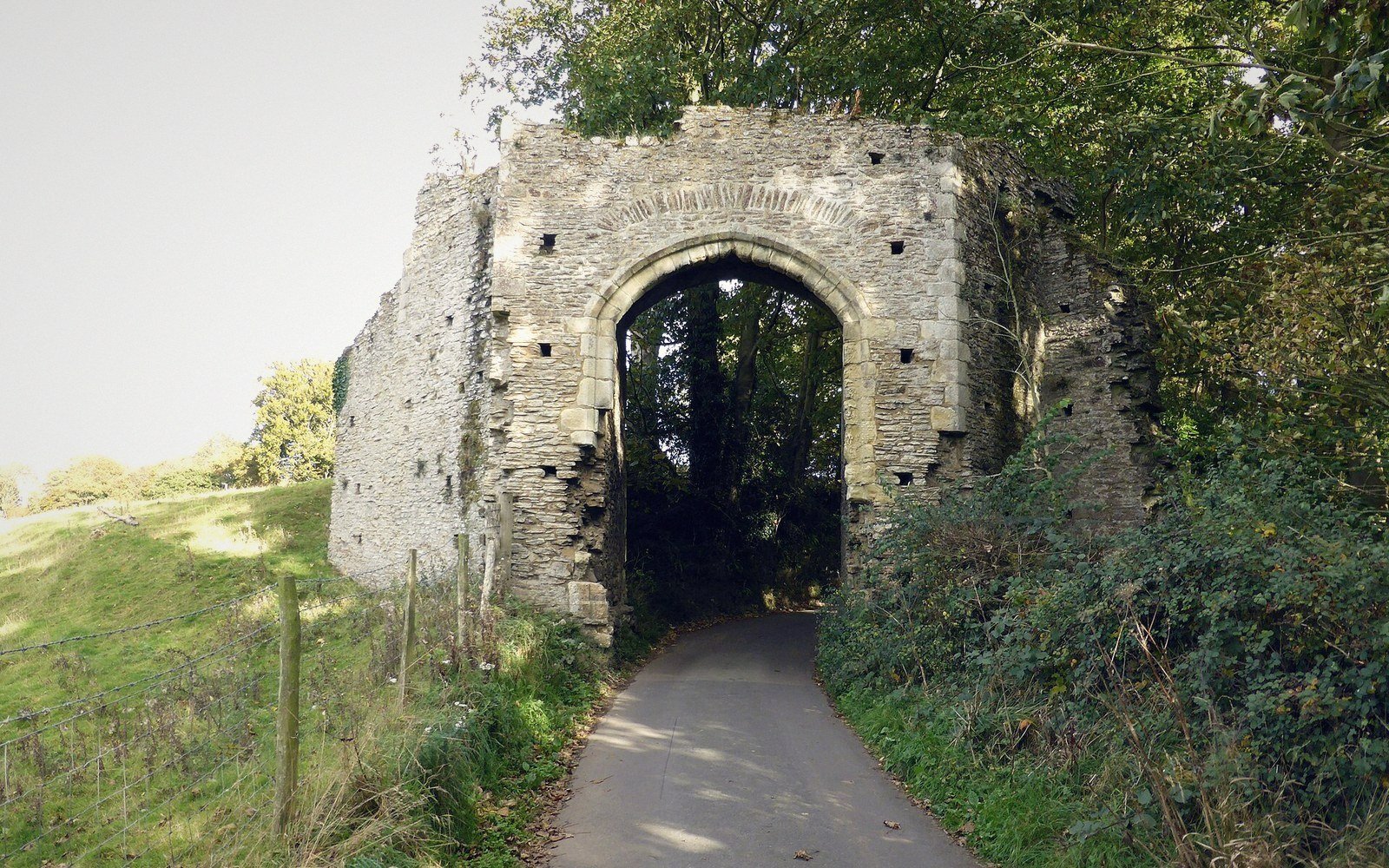
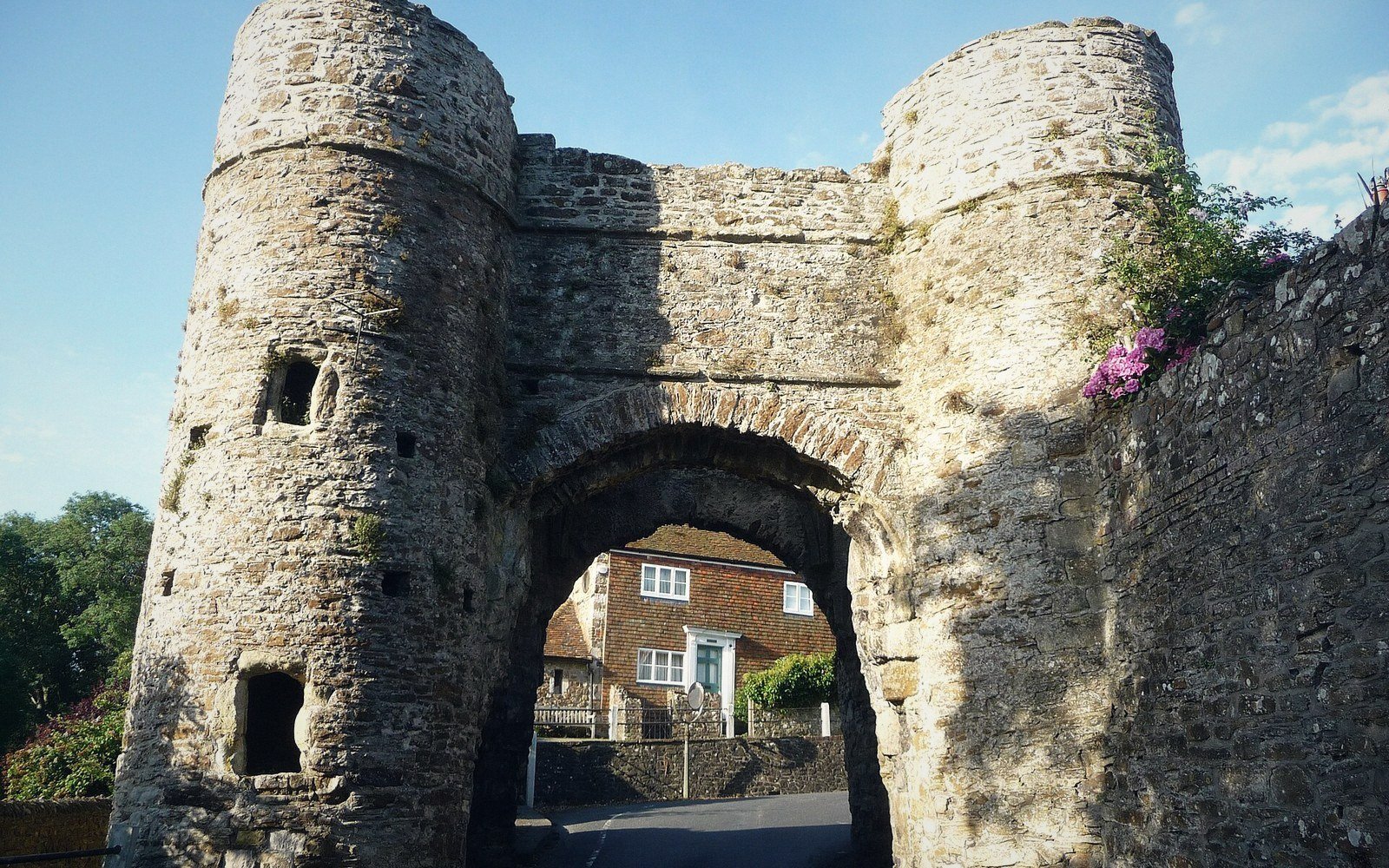
The intention was a circuit of walls and ditches to close the perimeter, anchored by formal gates. The Strand Gate, the Pipewell Gate and the New Gate survive — robustly, impressively, with real gatehouse chambers and portcullis grooves — and therein lies the paradox. The gates were built. The connecting walls, for most of the circuit, were not.
What was constructed amounts to fragments. A short length of masonry runs from the New Gate on the northeastern edge. Earthwork banks, interpreted as the intended line of the defences, are traceable in places around the perimeter, particularly where the outer quarters of the grid were never built upon and the ground remains open. But there is no continuous curtain wall, no walkway, no mural towers. Winchelsea is not, and apparently never was, a walled town in the way that contemporaries like Conway or Caernarfon — both Edwardian foundations of the same era — were walled towns.
Why the Money Stopped
The reasons are layered, and no single event explains the gap. Royal attention and royal funding, which had driven the initial foundation, shifted rapidly. Edward's ambitions in Wales and Scotland absorbed enormous resources through the 1290s and into the fourteenth century; a new town in Sussex, however strategically useful as a Cinque Port, was competing with campaigns that consumed everything. The infrastructure of Winchelsea — the grid, the church, the plots — was established through a burst of intent in the early 1290s, and much of the building that followed was done by the townspeople and merchants who moved there, not by the crown.
The Cinque Ports relationship complicated matters further. The town owed ship service to the crown in exchange for its privileges; it was not primarily a garrison. The energy and capital of its leading families went into the wine trade, the vaults beneath the plots, the church of St Thomas the Martyr. Walls were a public good requiring public money, and that money had other uses or simply was not forthcoming.
Chronology
5 entries · in order- 1280sNew Winchelsea founded on Iham ridge; grid and plots laid out
- Early 1290sMain phase of construction: church, gates, vaults established
- 1290s onwardRoyal funds redirected to Welsh and Scottish campaigns
- 1360, 1380Major French raids; significant destruction and population loss
- Later 14th–15th centuryTown contracts; outer quarters revert to grass; wall circuit never completed
Then the raids began. French forces attacked the town across the fourteenth century, burning and killing with a frequency that is sobering even at this distance. The attacks in 1360 and 1380 were severe. One consequence, which might seem counterintuitive, was that each raid set back the capacity to build: the town lost population, lost wealth, lost the merchant families whose investment would have funded any serious defensive work. A town contracting toward its church and its surviving centre had neither the population nor the resources to wall a perimeter drawn for a far larger settlement. The population that never arrived is part of the same story — fewer than a third of the planned quarters were ever fully built, and you cannot staff or maintain a wall circuit that encloses empty ground.

What the Gates Mean
The three gates should probably be understood not as fragments of an abandoned wall system but as something more deliberate: defended entry points on the principal approaches, capable of being held and of controlling movement, providing a degree of security without requiring the full circuit. The Strand Gate commands the steep descent toward the Brede valley and the old harbour approach. The New Gate controls the northeastern road. The Pipewell Gate, smaller and less formal, managed access near the water sources on the lower ground. Together they define the town's edges symbolically and practically even without the connecting masonry.
They also carried meaning. Gates were expensive, architecturally ambitious statements — they announced a town that expected to matter, that was worth defending, that had the status of a proper urban foundation. The financial and political logic of building the gates before the walls is not entirely opaque: a gate is visible, a gate proclaims, a gate can be built with a focused sum of money rather than the sustained, decade-long expenditure that a full wall circuit demands.
Whether the walls were always intended or whether the gates gradually came to substitute for them is a question the documents do not clearly answer. The earthwork evidence suggests genuine intent; the absence of masonry over several centuries suggests, at some point, that intent was quietly abandoned. By the time Winchelsea had decisively shrunk into its present form — a village occupying a fraction of its plan — the question of finishing the defences had become purely theoretical. The town inside the unbuilt walls was already smaller than any reasonable wall circuit would have enclosed.
Three gates stand in open fields and hedgerows. The walls they were waiting for never came.